Walking through Singapore’s gleaming financial district, you might not expect to stumble upon a Victorian-era cast-iron octagon serving some of the city’s best street food. But that’s exactly what Lau Pa Sat is—a 130-year-old national monument that’s still feeding thousands of hungry office workers, tourists, and locals every single day.
Perhaps you’ve heard about Satay Street, where Boon Tat Street closes to traffic each evening and transforms into an open-air barbecue haven. Or maybe you’re just looking for an honest meal in the CBD without the usual tourist-trap pricing. Either way, Lau Pa Sat sits at that interesting intersection of history, accessibility, and real food—the kind of place that feels both significant and effortlessly practical.
This guide walks you through everything you actually need: what Lau Pa Sat is, how Satay Street works, where to sit when it rains, which stalls deliver, and how to get there without circling the block three times looking for an entrance. No fluff, just the details that matter when you’re hungry and the clock’s ticking.
What Is Lau Pa Sat?
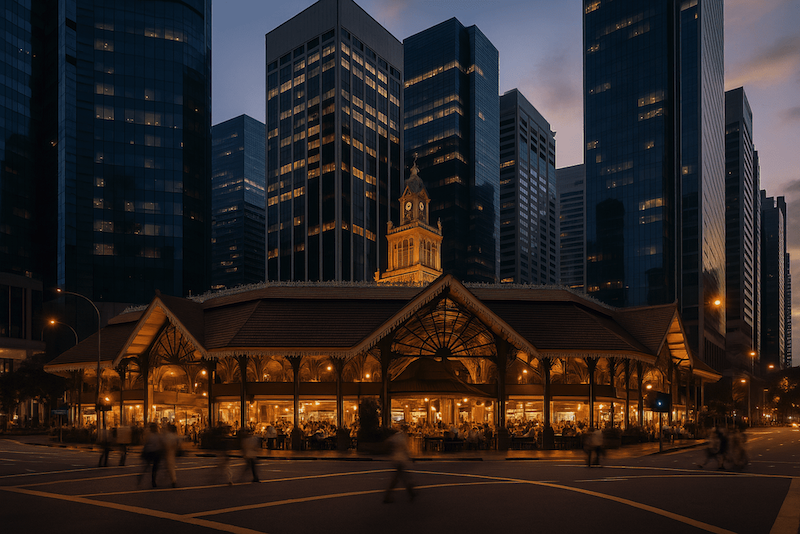
Lau Pa Sat—meaning “old market” in Hokkien—started life in 1824 as Singapore’s first fish market, built on timber pilings that extended into the sea so fishermen could unload their catch straight from boats. By 1894, after a couple of rebuilds and a land-reclamation project, it landed at its current spot on Raffles Quay in a stunning octagonal cast-iron structure imported piece by piece from Glasgow.
Today, it’s a 24-hour hawker centre with over 80 food stalls, Michelin-recognized vendors, and the famous Satay Street setup that draws evening crowds looking for charcoal-grilled skewers under the stars. It’s also a gazetted national monument—one of Singapore’s first, actually, recognized back in 1973 for its architectural and historical significance.
Lau Pa Sat vs. Telok Ayer Market—Same Place, Different Names
If you see “Telok Ayer Market” on old maps or heritage plaques, don’t worry—you’re in the right spot. Telok Ayer was the original colonial-era name, referencing the bay it once sat beside. When the structure was rebuilt and repurposed in the 1980s after MRT construction, it officially became Lau Pa Sat, though both names still float around interchangeably.
The name shift reflects the building’s evolution from a wet market selling fish and produce to a hawker centre focused purely on cooked food. For visitors, the takeaway is simple: Lau Pa Sat, Telok Ayer Market, and “that octagonal place near Raffles Place” all point to the same landmark.
Where Lau Pa Sat Sits in the CBD and Why It’s a Perfect First Meal
Lau Pa Sat occupies 18 Raffles Quay, wedged between the financial towers of Downtown Core and within easy walking distance of Marina Bay, Chinatown, and the Merlion. It’s roughly equidistant from three MRT stations—Raffles Place, Downtown, and Telok Ayer—so you’re never more than a five-minute walk from a train line.
Location-wise, it’s ideal for a first meal in Singapore because it offers variety (over 80 stalls covering Chinese, Malay, Indian, Indonesian, Thai, and Western options), it’s open around the clock, and it sits in a historic building that gives context to the city’s colonial past without requiring a museum ticket. You can eat breakfast dim sum at 9 a.m., grab noodles at 2 p.m. between meetings, or show up at 10 p.m. for satay and a beer—all at the same address.
Lau Pa Sat History and Architecture
Understanding a bit of Lau Pa Sat’s backstory makes the visit richer, especially when you notice the cast-iron columns, the octagonal layout, and the clock tower that still chimes on the hour.
From 1824 Fish Market to Octagonal Cast-Iron Hall in 1894
The first Telok Ayer Market opened in 1824 as a timber-and-attap structure on the waterfront, supervised by police officer Francis James Bernard. It was functional but flimsy—timber piles rotted fast, the attap roof violated fire codes, and by 1830 the whole thing was deemed “extremely unsafe.”
Architect George Drumgoole Coleman stepped in with a redesign in 1838, giving the market its signature octagonal shape with ornamental columns and a double-ring structure to let in light while sheltering vendors from monsoons. That building stood for four decades until land reclamation at Telok Ayer Basin required demolition in 1879.
Municipal Engineer James MacRitchie took over the next iteration, adapting Coleman’s octagonal concept but upgrading to prefabricated cast-iron frames shipped from Glasgow. Construction began in 1890 and wrapped up in 1894, resulting in the Victorian structure you see today—complete with filigree detailing, arched windows, and a clock tower imported from London.
National Monument Status and What That Means for Visitors
On June 28, 1973, the building was gazetted as a national monument in the pioneer batch of protected structures, recognizing it as one of Southeast Asia’s oldest Victorian cast-iron buildings and a rare example of prefabricated ironwork in Asia.
For visitors, monument status means the structure can’t be demolished or drastically altered, so the octagonal footprint, cast-iron columns, and general layout remain intact even as the food offerings modernize. It also means you’re eating inside a piece of living history—one that’s survived monsoons, war, land reclamation, MRT tunneling, and over a century of Singaporean appetites.
When the MRT’s Downtown Line was being built in the 1980s, workers carefully dismantled Lau Pa Sat piece by piece, installed the train tracks underneath, then reassembled the building on a new foundation. That level of care reflects the monument’s cultural value and Singapore’s broader commitment to preserving hawker culture alongside its skyline ambitions.
Satay Street at Lau Pa Sat
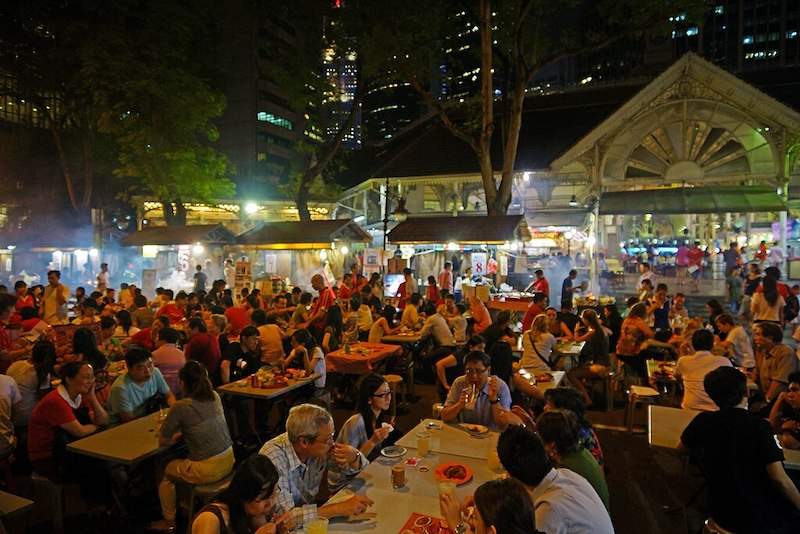
Every evening, Boon Tat Street—the road running along the southwest side of Lau Pa Sat—closes to vehicles and transforms into Satay Street, with rows of charcoal grills, plastic tables, and hawkers fanning skewers of marinated meat. It’s one of Singapore’s most photogenic dining experiences, and it’s a lot more straightforward than it looks once you understand the setup.
Satay Street Hours and Best Arrival Times to Avoid Queues
Satay Street operates on a split schedule:
- Weekdays: 7:00 p.m. to 3:00 a.m.
- Weekends (Saturday and Sunday): 3:00 p.m. to 3:00 a.m.
The vendors start setting up grills around 6:30 p.m. on weekdays, so if you arrive by 6:45 p.m., you can claim an outdoor table before the office crowd floods in. By 7:30 p.m., seating gets competitive, and you might wait 10–15 minutes for a spot. After 9 p.m., the rush eases slightly, though popular stalls like Best Satay 7 & 8 maintain steady lines all night.
On weekends, the earlier start at 3:00 p.m. means families and tourists can grab lunch-hour satay, but the real atmosphere kicks in after sunset when the street lights up and the smoke from a dozen grills hangs in the warm evening air.
If you want to skip the queue stress entirely, aim for weekday arrival between 6:30–6:50 p.m. or post-9:30 p.m., when you’ll still get fresh satay without the wait. Rainy evenings see fewer crowds, and while the grills keep running under awnings, most diners retreat inside Lau Pa Sat’s covered seating—which leads to the next point.
Ordering Flow, Table Tactics, and How Not to Get Stuck Waiting
Satay Street isn’t a formal restaurant—there’s no host, no reservation system, and no unified menu. Instead, you’ll encounter 8–10 independent satay vendors, each with their own grill cart and ordering slips. Here’s the typical flow:
- Find a table first. If you order before sitting, you’ll be juggling food while hunting for a spot. Outdoor tables fill fast, but the covered seating inside Lau Pa Sat connects seamlessly to Satay Street and works just as well if weather turns.
- Vendors will approach you. Once seated, hawkers circulate with laminated menus showing satay options (chicken, beef, lamb, prawns) and pricing. Stalls 7 & 8 are the most famous and often have the longest wait, but neighboring vendors like Stall 5 or Stall 6 deliver comparable quality with shorter turnaround.
- Order in multiples of 10. Satay is typically sold in sets of 5 or 10 sticks. A reasonable starting order for two people is 20–30 sticks total (mix of chicken, beef, and maybe a prawn skewer or two), plus drinks and a side of rice cakes (ketupat). Expect to pay around SGD 0.70–1.00 per stick for chicken or beef, SGD 1.50–2.00 for prawns.
- Drinks and sides come from different vendors. One hawker will handle satay, another will swing by with beer, soft drinks, or fresh coconut water. Pricing is clearly marked, and most accept cash or cards now, though cash speeds things up during peak hours.
- Wait time varies by stall. Popular stalls can take 15–20 minutes to grill your order during rushes. Less crowded vendors deliver in under 10 minutes. If you’re on a tight schedule, ask the vendor for an estimated wait before committing.
- Table sharing is normal. If the place is packed, you might share a long table with strangers. That’s expected, not awkward—just nod, claim your end, and focus on the food.
One insider tip: don’t over-order on the first round. It’s easy to get carried away when five different vendors are waving menus at you, but satay is richer than it looks, and 30 sticks plus sides will fill two adults comfortably. You can always order more if you’re still hungry, and the vendors are happy to return.
For a deeper breakdown of which satay stalls deliver the best value and how to pace your evening, that cluster guide covers stall-by-stall picks and budget strategies.
Best Food at Lau Pa Sat
Satay Street gets most of the attention, but the 80+ stalls inside Lau Pa Sat’s main hall offer a full spectrum of Singaporean and regional cuisines—many of them Michelin-recognized, halal-certified, or vegetarian-friendly. If you’re visiting for lunch or breakfast, or if the weather drives you indoors, here’s what actually works.
Quick Shortlist for First-Timers and Groups with Mixed Tastes
When you’re navigating Lau Pa Sat for the first time, these stalls offer solid, reliable options that cover the major food groups:
- Lao Fu Zi Fried Kway Teow (Stall 74–75): Michelin Bib Gourmand holder serving char kway teow with proper wok hei. Order the black version if you want the classic smoky flavor, white if you prefer it lighter. Plates start at SGD 7.50, and they also do laksa and boiled cockles.
- Feng Xiang Bak Kut Teh (Stall 27): A heady herbal pork rib soup that’s comforting any time of day, especially if you’re recovering from jet lag. The Herbal Bak Kut Teh costs SGD 8.50, and the Mixed Pig Organ Fried Porridge (SGD 7.50) offers something heartier.
- Nasi Lemak Ayam Taliwang (Stall 71): Another Michelin-recognized spot, and one of only two halal-certified stalls at Lau Pa Sat. Their signature Nasi Lemak with spicy Indonesian grilled chicken, coconut rice, sambal, and ikan bilis runs SGD 8.50. Open until midnight, which is rare for non-satay vendors here.
- LiXin Teochew Fishball Noodles (Stall 32): A reliable fishball noodle franchise with a Michelin Bib Gourmand. The handmade fishballs are bouncy, the chili-vinegar condiment is punchy, and a bowl costs SGD 6. Good for a quick, no-fuss lunch.
- Seng Kee Local Delights (Stall 57): One-stop stall offering Fried Kway Teow, Laksa (SGD 6.80), and Hokkien Mee (SGD 6.80). The laksa gets steady praise for its coconut broth and seafood ratio.
- Butter & Cream (Stalls 5–6): If you’re craving something sweet or want a breakfast option, Butter & Cream does freshly baked muffins with flavors like Oreo Chocolate and S’mores, plus egg tarts and other pastries. A nice palate cleanser after savory overload.
These stalls cluster near the center and edges of the octagonal hall, and most stay open from mid-morning until 9–10 p.m. A few vendors, like Nasi Lemak Ayam Taliwang, push past midnight, but don’t bank on full selection after 10 p.m. unless you’re at Satay Street.
Vegetarian, Halal, and Kid-Friendly Options You’ll Actually Use
Lau Pa Sat isn’t a niche diet paradise, but it does have practical options if you or someone in your group has dietary restrictions:
Halal-certified:
- Nasi Lemak Ayam Taliwang (Stall 71): Full halal certification, Michelin-recognized, open late.
- Munchi Pancakes (Stall 61): Halal-certified Malaysian pancakes (min jiang kueh) with fillings like black sesame, peanut, and red bean. Open 8 a.m.–8:30 p.m.
Vegetarian and vegan-friendly:
- Maya Veggie Delight (Stall 47): Pure Indian vegetarian stall with options like Vegetarian Biryani (SGD 7), daal, papadum, and soy-based mock meat. One of the few fully plant-based spots in the hall.
- Mint @ 31: Another Indian vegetarian stall offering seasoned vegetables, curries, and grain-based dishes. Works well for vegans if you skip dairy-based curries.
- Thunder Tea Rice: No pork or lard, though not halal-certified. A nutritious bowl of mixed vegetables, herbs, tofu, and grains with a tea-based soup poured over it. Acquired taste, but wholesome.
Kid-friendly picks:
- Chicken rice from any of the Hainanese stalls—mild, familiar, and universally accepted by young eaters.
- Fried rice and noodles from stalls like Mr Rice Pao Fan & Fried Rice or Seng Kee.
- Dim sum from the morning vendors (steamed buns, dumplings, siu mai) if you’re visiting for breakfast.
- Muffins and pastries from Butter & Cream for a sweet treat or snack.
One thing to note: Lau Pa Sat doesn’t have high chairs or dedicated kids’ menus, but hawker centres are inherently family-friendly spaces where children are welcome and common. The open layout means kids can move around a bit, and the food variety ensures even picky eaters will find something they’ll actually eat.
For a full stall-by-stall breakdown with prices, opening hours, and signature dishes, check the dedicated best stalls guide.
Lau Pa Sat Practical Guide
Once you’ve decided what to eat, the next layer of friction comes from figuring out logistics—where exactly you are, how to pay, where the restrooms hide, and whether tonight’s random live music event is worth staying for. Here’s the practical layer.
Address and Map Pin to Share with Your Group
Full address: 18 Raffles Quay, Singapore 048582
Drop that into Google Maps, Apple Maps, or Grab, and you’ll land at the correct entrance. The building occupies a full block, so depending on which direction you’re approaching from, you might enter via Cross Street (northwest side), Boon Tat Street (southwest, where Satay Street sets up), or Robinson Road (north side). All entrances lead into the same octagonal hall, so you can’t really get lost—just walk toward the food.
If you’re coordinating with friends, “meet at the clock tower” works as a central landmark inside, or “outside Satay Street” if it’s evening and the grills are running.
Payment Basics—Cash vs. Card vs. Mobile, and Where to Find ATMs
Lau Pa Sat modernized its payment systems in recent years, and most stalls inside the main hall now accept major credit cards (Visa, Mastercard) and mobile payments via the FairPrice Group app, which also offers discounts and loyalty points if you’re a frequent visitor or staying nearby for a few days.
That said:
- Satay Street vendors are a mixed bag. Some accept cards, but cash is still king for speed and simplicity. Bring at least SGD 50–100 per person if you’re planning a full satay dinner with drinks.
- Smaller stalls and dessert vendors may prefer cash, especially during peak hours when card terminals slow down.
- ATMs are available at nearby buildings (Hong Leong Building, One Raffles Quay, Raffles Place MRT station), all within 2–3 minutes’ walk. Roadside parking meters and convenience stores also cluster around the area if you need to break a large bill.
A practical tip: avoid using SGD 50 or SGD 100 notes at hawker stalls. Most vendors prefer smaller denominations (SGD 10, SGD 5, coins), and some may not have enough change during busy periods. Hit an ATM or 7-Eleven beforehand to break your bills.
Events, Live Music Nights, and Seasonal Activations to Watch
Lau Pa Sat occasionally hosts live music, cultural performances, and themed food festivals—especially during major holidays like Chinese New Year, National Day, and the year-end festive season. These events add a layer of energy to the space, though they also mean bigger crowds and sometimes slightly inflated prices at participating stalls.
Check Lau Pa Sat’s official Instagram (@laupasat.sg) or website for upcoming activations. Past events have included a “Hawker Mayhem” Lady Gaga-inspired carnival, weekend live bands, and weekend carnivals featuring pop-up stalls and international cuisines.
If you’re visiting purely for the food and want a quieter experience, avoid event nights. But if you’re open to a more festive, chaotic vibe—especially with kids or a group—timing your visit around one of these activations can make the trip more memorable.
Restrooms, Seating Zones, and What to Do When It Rains
Restrooms: Free public toilets are located outside the main hall, accessible from the exterior walkways. Signage is clear, and you’ll find them near the corners of the octagonal structure. They’re basic, clean enough for a hawker centre, and equipped with toilet paper and soap, though paper towels are typically absent. Bring your own tissues or hand sanitizer if you’re particular.
Seating zones: Lau Pa Sat has roughly 2,500 seats spread across communal tables arranged in the eight radiating sections of the octagon. Seating is free and open—no reservations, no table fees. Most tables seat 4–6 people comfortably, though solo diners and couples often share larger tables during peak hours.
The center of the hall houses a drinks kiosk, with walkways radiating outward toward the food stalls along the perimeter. If you prefer fan coverage, aim for tables near the large industrial fans mounted around the hall. If you want a view of Satay Street’s grills and evening action, grab a table along the Boon Tat Street side.
Rain contingencies: Singapore’s tropical climate means sudden downpours are common, especially in the afternoon and early evening. Lau Pa Sat’s covered hall keeps you dry, so if rain hits while you’re at Satay Street, just move inside with your food and drinks. The vendors will keep grilling under their awnings, and you can still order and eat comfortably inside.
If it’s actively raining when you arrive, consider skipping Satay Street entirely and focusing on the indoor stalls. The experience is just as authentic, and you’ll avoid the soggy-table chaos that happens when 300 people suddenly rush for cover.
How to Get to Lau Pa Sat
Lau Pa Sat sits in one of the most transit-accessible pockets of Singapore, with three MRT stations within easy walking distance and multiple bus routes connecting to the CBD. Here’s how to get there without second-guessing your route.
From Raffles Place, Downtown, and Telok Ayer—Simple Step-by-Step
From Raffles Place MRT (NS26/EW14 – North-South Line and East-West Line):
- Exit the station via Exit I, which brings you to Finlayson Green.
- Turn left onto Robinson Road and walk southwest for about 450 meters (6 minutes).
- You’ll see Lau Pa Sat’s octagonal structure on your right as you approach the intersection with Boon Tat Street.
Raffles Place is the busiest interchange in the area, so expect crowds during morning and evening rush hours. Exit I is the most direct route to Lau Pa Sat, though other exits also work—you’ll just add a minute or two of walking.
From Downtown MRT (DT17 – Downtown Line):
- Exit via Exit E, which places you on Cross Street.
- Walk northwest along Cross Street for about 350 meters (5 minutes).
- Lau Pa Sat will appear on your left at the corner of Cross Street and Boon Tat Street.
Downtown Station is slightly closer than Raffles Place and less crowded, making it a good choice if you’re coming from areas like Bugis, Little India, or Chinatown via the Downtown Line.
From Telok Ayer MRT (DT18 – Downtown Line):
- Exit via Exit A, which opens onto Cross Street.
- Walk southeast along Cross Street for about 250 meters (3 minutes).
- Lau Pa Sat sits at the corner of Cross Street and Raffles Quay—you can’t miss the octagonal structure.
Telok Ayer is the closest station and the fastest walk, making it ideal if you’re already in the Chinatown or Tanjong Pagar area. The station also connects to several heritage temples and clan associations, so you can bundle Lau Pa Sat with a quick heritage walk through the Telok Ayer conservation district.
For a more detailed breakdown of each MRT route, including platform-level navigation and alternative exits, the dedicated MRT access guide covers step-by-step instructions with maps and walking times.
Late-Night Exits, Pickup Points, and Wet-Weather Routes That Help
If you’re leaving Lau Pa Sat after 11 p.m.—common if you’re lingering at Satay Street—MRT service might be winding down or already closed, depending on the day and line. Singapore’s MRT typically runs until around midnight on weekdays and slightly later on weekends, but the last train from Raffles Place or Telok Ayer usually departs between 11:30 p.m. and 12:30 a.m.
Late-night options:
- Grab or taxi: The most reliable post-midnight option. Designated pickup points are located along Boon Tat Street (outside the satay area once the road reopens to traffic) and Robinson Road (north side of Lau Pa Sat). Fares from Lau Pa Sat to most central hotels or attractions run SGD 8–15, depending on traffic and surge pricing.
- Night buses: Service 97e and NL1 (night loop) run through the CBD and connect to other parts of Singapore, though frequency drops after midnight. Check the LTA (Land Transport Authority) website or the SG Buses app for current schedules.
Wet-weather routes: When rain hits, the covered walkways connecting office buildings in the CBD become your best friend. From Raffles Place MRT, you can use the underground passages and elevated walkways to reach buildings like One Raffles Quay or Hong Leong Building, then pop out much closer to Lau Pa Sat with minimal exposure to rain.
From Downtown or Telok Ayer, Cross Street has awnings and shophouse overhangs that provide partial cover, but you’ll still get damp in a heavy downpour. If you’re visiting on a rainy evening, consider dining inside the covered hall first, then venturing to Satay Street if the weather clears.
FAQs About Lau Pa Sat
A few questions come up repeatedly from first-time visitors, so here are fast, practical answers to save you the search.
Is Lau Pa Sat Open 24/7 and Do All Stalls Keep Late Hours?
Lau Pa Sat itself operates 24 hours daily—the building never closes. However, individual stalls have their own hours, and the full selection is really only available between 10 a.m. and 10 p.m.
Typical stall hours:
- Breakfast/dim sum vendors: 8 a.m.–11 a.m.
- Lunch stalls: 10 a.m.–9 p.m. (some until 10 p.m.)
- Late-night options: Nasi Lemak Ayam Taliwang (until midnight), Satay Street vendors (weekdays until 3 a.m., weekends until 3 a.m.)
If you show up at 2 a.m. on a Wednesday, expect Satay Street to still be running but most indoor stalls to be shuttered. The 24-hour claim is technically accurate but functionally limited outside peak hours.
Do You Need to Book a Table for Satay Street or Just Show Up?
No reservations, no table bookings. Satay Street operates on a first-come, first-served basis. You show up, find a table (or wait for one if it’s crowded), and vendors approach you to take orders.
If you’re visiting with a large group (8+ people) during peak hours, arrive early (6:30–6:45 p.m. on weekdays) to claim adjacent tables. Otherwise, you’ll end up split across the hall, which isn’t the end of the world but makes shared ordering and conversation harder.
Is Lau Pa Sat a Tourist Trap or Worth the Hype?
This one comes up a lot in Reddit threads and travel forums, usually framed as “overpriced tourist trap” vs. “authentic local experience.” The truth sits somewhere in the middle, and it depends on what you order and when you visit.
Where the “tourist trap” critique has merit:
- Satay Street pricing is slightly higher than neighborhood hawker centres. You’ll pay SGD 0.70–1.00 per stick here vs. SGD 0.50–0.70 at less central spots.
- Some vendors (especially at Satay Street) can be pushy, waving menus aggressively and pressuring you to order extras like prawns or roti that inflate the bill.
- Location in the CBD means a captive audience of office workers and tourists, so stalls can get away with premium pricing without losing customers.
Where Lau Pa Sat still delivers value:
- The food quality at Michelin-recognized stalls (Lao Fu Zi, LiXin, Nasi Lemak Ayam Taliwang) is genuinely good and priced comparably to other Michelin Bib Gourmand hawker stalls across Singapore.
- Satay Street’s open-air, charcoal-grill atmosphere is unique—there’s no other spot in Singapore where you can sit in the middle of a closed road with a dozen satay vendors grilling around you.
- Convenience and accessibility make Lau Pa Sat a practical choice for first-time visitors who don’t have time to trek to neighborhood hawker centres in Bedok or Ang Mo Kio.
Bottom line: If you’re expecting rock-bottom hawker prices and zero tourist presence, you’ll be disappointed. But if you accept that central location and convenience come with a small markup, and you stick to well-reviewed stalls, Lau Pa Sat offers a solid, atmospheric meal that feels distinctly Singaporean without being a total rip-off.
What’s the Best Time to Visit to Avoid Crowds?
The lunch rush (12 p.m.–2 p.m. on weekdays) is the single worst time to visit if you want a relaxed experience. The financial district empties into Lau Pa Sat, and seating becomes a competitive sport.
Best times for a quieter visit:
- Weekday mornings (8 a.m.–11 a.m.): Breakfast crowd is thinner, dim sum and kaya toast vendors are open, and you’ll find plenty of seating.
- Mid-afternoon (2 p.m.–5 p.m.): The post-lunch lull. Many stalls are still open, seating is plentiful, and the heat is more manageable under the covered hall.
- Late evening (9:30 p.m. onwards): Satay Street is still bustling, but the dinner rush has passed, and you’ll wait less for food and tables.
Times to avoid if you dislike crowds:
- Weekday lunch (12 p.m.–2 p.m.)
- Satay Street opening rush (7 p.m.–8:30 p.m. weekdays, 3 p.m.–6 p.m. weekends)
- Event nights (check Instagram for announcements)
Is Lau Pa Sat Family-Friendly and Safe for Kids?
Yes. Hawker centres are everyday dining spaces for Singaporean families, and you’ll see kids of all ages running around, eating at tables, and generally making themselves at home. Lau Pa Sat doesn’t have high chairs, changing tables, or dedicated kids’ menus, but the open layout, variety of food, and casual atmosphere make it practical for families.
Things that help with kids:
- Wide food variety means picky eaters can find something they’ll accept (chicken rice, noodles, fried rice).
- Restrooms are free and accessible, though basic.
- The space is open and well-lit, so parents can keep an eye on wandering toddlers.
- Satay Street’s open-air setup and charcoal grills fascinate kids, making the meal more of an experience than a chore.
Things to be aware of:
- No air conditioning—Lau Pa Sat is open-air with fans, so it gets warm, especially in the afternoon. Dress kids in light clothes and bring water.
- Crowded during peak hours, which can be stressful with a stroller or very young children. Visit during off-peak times if possible.
- Smoke from Satay Street grills can be intense for sensitive kids (or adults). If it’s too much, retreat inside the covered hall.
Singapore itself is one of the safest cities in the world, and Lau Pa Sat sits in a well-policed, well-lit area with heavy foot traffic. You’re not going to encounter safety issues, even late at night.
Can You Park Near Lau Pa Sat?
Yes, but parking in Singapore’s CBD is expensive and limited. If you’re driving, expect to pay SGD 3–4 per hour on weekdays, with slightly lower rates in the evenings and on weekends.
Nearby car parks:
- Hong Leong Building (16 Raffles Quay) – 0.1 km away
- One Raffles Quay – 0.17 km away
- Tong Eng Building (101 Cecil Street) – 0.12 km away
- CapitaGreen (138 Market Street) – 0.14 km away
Most commercial car parks in the area charge SGD 2.50–3.50 per half hour during business hours, dropping to a flat SGD 3–4 per entry after 6 p.m. Roadside parking along Circular Road, North Canal Road, or Boon Tat Street is cheaper (SGD 1.20 per half hour) but highly competitive.
Realistically, unless you’re already driving in the area or have mobility issues, MRT or Grab/taxi is faster and cheaper than parking near Lau Pa Sat. Singapore’s public transport is reliable, frequent, and affordable—use it.
Why Lau Pa Sat Still Matters
Singapore’s hawker centres are under pressure—from rising costs, generational shifts as younger Singaporeans opt for air-conditioned food courts, and redevelopment that periodically shutters old markets for years at a time. Lau Pa Sat, by contrast, has stayed continuously operational since 1894 (except for a brief MRT construction pause), making it not just a place to eat but a tangible link to the city’s food culture and colonial history.
The cast-iron structure, the octagonal layout adapted from George Coleman’s 1838 design, the clock tower that still chimes—these aren’t museum pieces. They’re functional elements of a working hawker centre that feeds thousands every day, bridging the gap between heritage preservation and everyday utility.
Satay Street, for all its tourist buzz, represents something equally important: a public space where car traffic yields to food and people, where charcoal smoke and conversation drown out the hum of the financial district, and where a SGD 10 meal can still feel like an event. Not every city manages that balance, and not every historic building survives long enough to see it.
Whether you’re here for the Michelin-recognized char kway teow, the Instagram-ready satay grills, or just a bowl of fishball noodles between meetings, Lau Pa Sat delivers on the promise of hawker culture: good food, accessible prices, and a space where everyone—locals, expats, tourists, families, solo travelers—can pull up a chair and eat without pretense.
So show up. Eat the satay. Try a stall you’ve never heard of. Sit inside when it rains and outside when the smoke from the grills smells too good to resist. And if you get lost navigating the octagonal layout or forget which MRT exit to take, well, that’s part of it too. The building’s been standing for 130 years—it can handle a little confusion.