I remember sitting at my laptop at 2 AM, frantically refreshing the Madhya Pradesh forest department website, trying to figure out why my Kanha safari booking kept failing. The website interface was confusing, I wasn’t sure which ID proof to submit, and I had no idea if I should book Mukki zone or Kisli zone. Sound familiar?
If you’re planning a trip to Kanha National Park and feeling overwhelmed by the booking process, you’re not alone. The online safari booking system can be… well, let’s just say it’s not the most intuitive system out there. But here’s the thing: once you understand how it works, it’s actually pretty straightforward. And getting those safari permits sorted well in advance is absolutely crucial if you want to see tigers in one of India’s most spectacular national parks.
In this guide, I’m going to walk you through everything I wish someone had explained to me before I started booking. We’ll cover the official booking process, the documentation you need, the payment structure, how to choose zones, what to do if slots are full, and all those little details that can make or break your Kanha experience. By the end, you’ll feel confident navigating the booking system and securing those precious safari slots.
Let’s dive in, because understanding safari costs in Kanha starts with knowing how to actually book them.
Understanding the Kanha Safari Booking System
Before we get into the step-by-step process, let me explain how the system actually works—because understanding the why behind the rules makes everything else easier.
The entire safari booking system for Kanha National Park is controlled and managed by the Forest Department of Madhya Pradesh, which operates under the state government’s forest ministry. This isn’t run by private tour operators or hotels—it’s a government-managed system designed to regulate tourist numbers and minimize ecological impact.
Here’s what that means practically: the number of jeeps allowed into each zone per safari slot is strictly limited. This isn’t about making your life difficult; it’s about protecting the park’s fragile ecosystem. The National Tiger Conservation Authority (NTCA) has established eco-tourism guidelines that mandate these vehicle limits to reduce disturbance to wildlife.
Safaris operate in two shifts daily—morning and afternoon—and only in six-seater open jeeps. No private vehicles are allowed inside the core zones. The forest department assigns safari vehicles, guides, and even the safari gate on a somewhat random basis, which means you don’t always get to choose every detail of your experience.
This randomness frustrates some visitors, I’ll admit. But I’ve come to see it as fair—it prevents certain zones from getting overcrowded while others sit empty, and it ensures that everyone has roughly equal chances of good wildlife sightings regardless of how much they’re willing to pay for “premium” access.
How Far in Advance Should You Book?
This is probably the most important question, and the answer depends on whether you’re an Indian national or a foreign visitor.
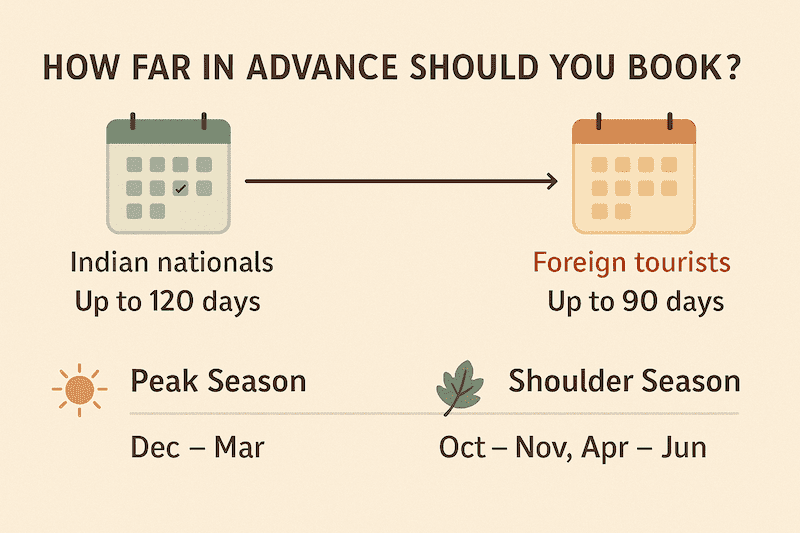
For Indian nationals: The system allows booking up to 120 days (approximately 4 months) in advance, though some sources suggest 30 days is the practical minimum for securing good slots during regular season.
For foreign nationals: You can book up to 90 days in advance.
Now, here’s my honest recommendation based on both my experience and what I’ve learned from talking to frequent Kanha visitors: book as early as the system allows, especially if you’re visiting during peak season (roughly December through March, plus long weekends and Indian holidays).
During peak periods, safari slots—particularly for the popular Mukki and Kanha zones—fill up within hours of becoming available. I’m not exaggerating. If you wait until a month before your trip thinking “I’ll book then,” you might find every single morning safari slot already taken.
If you’re visiting during the shoulder months (October-November or April-June), you have a bit more flexibility. But even then, booking at least 30-45 days ahead gives you better choices and less stress.
One more thing to consider: if you’re coordinating your safari bookings with specific accommodation, you want everything aligned. Booking safaris early allows you to then find hotels or resorts near the appropriate gates, rather than booking accommodation first and discovering later that you can’t get safaris from that location.
Step-by-Step Kanha Safari Booking Process
Alright, let’s walk through the actual booking process. I’ll break this down into clear steps so you can follow along when you’re ready to book.
Step 1: Register on the MP Forest Website
The official booking portal is forest.mponline.gov.in. This is the legitimate government website—be careful of third-party sites that might charge you extra fees for what should be a straightforward process.
You’ll need to create an account by registering with:
- Your mobile number (make sure it’s active, as you’ll receive OTP verification)
- Email address
- Basic personal information
The registration process is fairly standard, though the website interface looks a bit dated. Don’t let that throw you off—it works, just not always elegantly.
Step 2: Navigate to Wildlife Section
After logging in, find the “Wildlife” or “Safari Booking” section. The exact wording varies depending on when the site was last updated, but you’re looking for options related to national park or tiger reserve bookings.
Select “Kanha Tiger Reserve” from the list of available parks. You’ll then see options for different zones and time slots.
Step 3: Select Your Safari Details
This is where you make the key decisions:
Date: Choose your preferred safari date. The system will show you availability for that date.
Time Slot: Morning or afternoon safari. (We’ll discuss timing pros and cons later, but generally morning safaris have better wildlife activity.)
Zone Preference: You can indicate a preferred zone (Kanha, Kisli, Mukki, or Sarhi for core zones), but the forest department makes the final allocation based on availability. More on zones in the next section.
Booking Type: Full vehicle (private jeep for your group) or single seat (sharing with other tourists). Most people book full vehicles for flexibility and privacy.
Step 4: Enter Tourist Details
Here’s where many people make mistakes that lead to permit cancellation at the gate, so pay attention:
For each person in your group, you must provide:
- Full name exactly as it appears on their government-issued photo ID
- Age
- Gender
- Nationality
- ID type and number (Passport, Driving License, Voter ID, PAN Card, Aadhaar Card, or School ID for students)
The forest department is strict about this: if the name on your ID doesn’t match the name you provided during booking, or if you show up with a different ID than the one you registered, they can and will cancel your permit at the entrance. No refunds, no exceptions. I’ve seen this happen, and it’s heartbreaking to watch someone get turned away after traveling all the way to the park.
Double-check every letter, every number. If someone in your group recently got married and changed their name, make sure the ID they’re carrying matches what you’re entering in the system.
For foreign nationals, passport is mandatory—no other ID will be accepted.
Step 5: Payment
Once you’ve entered all details, you’ll see the total cost breakdown. The permit fees typically include:
- Park entry fee
- Vehicle fee
- Guide fee
- Processing/service charges
- GST
However—and this is important—the vehicle, driver, and guide charges (approximately INR3,600) are often paid separately at the time of safari boarding, not during online booking. The exact split varies slightly depending on whether you’re booking through the official portal or through registered tour operators.
For weekday core zone safaris, Indian nationals typically pay INR3,900 to INR4,400 at the time of online booking, plus the INR3,600 vehicle/driver/guide charges at the gate. Weekends cost slightly more (INR4,400 online booking fee). Foreign nationals pay significantly higher rates.
Payment is made via the government portal using debit/credit cards, net banking, or UPI. Make sure you save the transaction confirmation and booking receipt—you’ll need to present this at the park entrance.
Step 6: Receive Confirmation and Permit
After successful payment, you’ll receive a permit with a unique Permit ID via email and SMS. This permit will specify:
- Permit ID and QR code
- Permit status
- Safari date and time slot
- Entry gate
- Safari zone (assigned by the forest department)
- Names and details of all tourists
Download and print this permit, or at minimum have it accessible on your phone. You’ll need to show it at the gate along with your original IDs.
Choosing Your Safari Zone (Or Understanding Why You Can’t)
This is one of the most confusing aspects for first-time visitors, so let me break down how zone allocation actually works.
Kanha has four core zones where most wildlife sightings occur:
- Kanha Zone: The premium zone located in the middle of the core area. Features open meadows, grasslands, and bamboo vegetation. The famous Schaller Road is here, named after researcher George Schaller who studied tigers in Kanha.
- Kisli Zone: Characterized by elegant sal forests, scenic grasslands, and bamboo areas. This is often the “default” zone for visitors entering through Khatia Gate.
- Mukki Zone: Known for relatively frequent tiger sightings and diverse terrain. Many guides consider this the best zone for big cat encounters.
- Sarhi Zone: Dry deciduous forests with expansive meadows, accessed through a shared route that passes through Kisli.
There are also four buffer zones (Khatia, Khapa, Sijora, and Phen) which cost less but generally offer fewer tiger sightings, though they’re excellent for birds and other wildlife.
Here’s the catch: you don’t get to firmly choose your zone. You can express a preference during booking, but the forest department assigns zones randomly based on availability and their allocation system. The idea is to distribute tourist pressure evenly across zones and prevent overcrowding in any single area.
The entry gate, however, does matter because different gates access different combinations of zones. If you understand the features of each Kanha safari zone, you can make more strategic accommodation decisions.
Khatia Gate provides access to all four core zones plus the Khatia buffer zone. This is why many visitors stay near Khatia—maximum flexibility.
Mukki Gate accesses Kanha, Kisli, and Mukki zones, plus Khapa buffer zone.
Sarhi Gate accesses Kanha, Kisli, and Sarhi zones, plus Sijora buffer zone.
If you’re booking through tour operators instead of directly through the government portal, they might have slightly more influence over zone allocation based on their relationships with the forest department, but even that isn’t guaranteed.
My advice? Book multiple safaris across your stay and accept that you’ll probably see different zones. This actually works in your favor—different zones have different landscapes and different resident tiger territories, so varying your zones increases your overall chances of sightings.
Safari Timings and What They Mean for Wildlife Viewing
Safari timings vary by season to align with sunrise and sunset times. Here’s the general schedule:
October 16 to February 15:
- Morning safari: 6:30 AM to 11:30 AM
- Afternoon safari: 2:30 PM to 5:30 PM
February 16 to March 31:
- Morning safari: 6:00 AM to 11:00 AM
- Afternoon safari: 3:00 PM to 6:00 PM
April 1 to June 30:
- Morning safari: 5:30 AM to 10:00 AM
- Afternoon safari: 4:00 PM to 7:00 PM
These are approximate—slight variations occur based on exact sunrise/sunset times.
Now, which should you book—morning or afternoon?
Most wildlife experts and guides recommend morning safaris. Animals are generally more active in the cooler early hours. Tigers often patrol their territories at dawn, visiting water sources before the heat of the day sets in. The lighting is also better for photography in the morning, with soft golden light filtering through the forest.
That said, I’ve had fantastic afternoon safaris too. Tigers don’t consult our schedules before deciding to hunt or move about. Afternoon safaris are typically less crowded, which some people prefer. And if you’re visiting in winter, animals often come out in the afternoon sun to warm themselves.
If you can, book both. A morning safari followed by a day of rest, then an afternoon safari gives you the best of both time slots without exhausting yourself.
Booking Through Tour Operators vs. Official Portal
You have two main options for booking: directly through the government portal or through registered tour operators. Each has pros and cons.
Official Portal (forest.mponline.gov.in):
Pros:
- No middleman markup
- Direct access to all available slots
- Full transparency on costs
Cons:
- Website interface can be clunky and confusing
- No personal assistance if you have questions
- You handle all logistics yourself
- Limited zone choice—purely random allocation
Registered Tour Operators:
Pros:
- Expert guidance on zones, timing, and strategy
- They handle all booking paperwork
- Often bundle accommodation, transport, and safaris into packages
- May have marginally better access to preferred zones through relationships
- Assist if problems arise at the gate
Cons:
- Service charges added to base cost (typically INR500-INR2,000 per safari)
- You’re relying on someone else’s timeline
- Quality varies significantly between operators
Honestly? If you’re comfortable with online systems and enjoy planning your own travel, book directly through the portal. You’ll save money and maintain full control. If you prefer convenience and don’t mind paying a bit extra, or if you’re booking a full package with accommodation and transport, a reputable tour operator makes sense.
Just make sure any operator you use is officially registered with the MP Forest Department. There are unfortunately some unscrupulous operators who take bookings and payments without actually securing permits.
What to Do When Safari Slots Are Full
Okay, worst-case scenario: you try to book and every slot for your dates is showing “Not Available.” Don’t panic. You have options.
1. Check Multiple Dates
If your travel dates have any flexibility at all, try dates a day or two earlier or later. Sometimes a single day shift opens up completely different availability.
2. Consider Buffer Zones
Buffer zone safaris cost less (around INR7,000-INR8,000 for Indian nationals) and are often available when core zones are full. While tiger sightings are less common, buffer zones offer excellent birding, and you’d be surprised how many other animals you’ll encounter. Plus, they’re less crowded, which creates a more peaceful experience.
3. Try Different Time Slots
If morning safaris are booked out, check afternoon slots and vice versa.
4. Last-Minute Walk-In Bookings
The park maintains a small quota of same-day safari slots available at the official booking counters near the park gates. This is first-come, first-served, so you’d need to arrive at least one hour before the safari starts. It’s risky—slots might not be available—but it’s an option if you’re already in the area.
5. Contact Registered Tour Operators
Sometimes operators have access to slots that don’t show as available on the public portal, or they might have a cancellation from another client. It’s worth calling a few operators to check.
6. Plan for a Longer Stay
If you can extend your visit by even one day, you might find availability outside the peak dates. This is where knowing the best time to visit Kanha for wildlife helps—visiting during shoulder season increases your chances of getting slots.
Cancellation and Refund Policies
Life happens. Plans change. So what if you need to cancel or modify your safari booking?
Here’s the unfortunate reality: safari permits are largely non-refundable and non-transferable. However, the exact cancellation policy varies depending on whether you booked through the official portal, a tour operator, or as part of a package deal.
The general cancellation structure looks something like this:
- More than 30 days before safari: 10-25% cancellation charge
- 15-29 days before safari: 30-40% cancellation charge
- 7-14 days before safari: 40-50% cancellation charge
- 2-6 days before safari: 50-60% cancellation charge
- Less than 48 hours or no-show: 100% charge (no refund)
Some operators state flatly that jeep safari bookings are completely non-refundable regardless of timing, so check your specific booking terms carefully.
Modifications are similarly restricted. If your safari date is within 30 days, even slight modifications usually aren’t allowed. If you’re more than 30 days out, modifications might be possible with penalty charges.
If you need to cancel or modify, you must notify in writing (email) as soon as possible. Cancellation charges begin from the date they receive your written notice, not from when you verbally mentioned it.
One exception: force majeure events (natural disasters, park closures by forest department, etc.) may result in full or partial refunds, but this is reviewed case-by-case.
My recommendation? Don’t book safaris until you’re absolutely certain of your travel dates. And consider travel insurance that covers non-refundable activity bookings if you’re booking many months in advance.
Important Rules and Regulations to Remember
Let’s cover some essential rules that affect your safari experience:
Maximum Occupancy: Six adults maximum per jeep. Children under 5 years can sit with family members (no separate seat). Children who need their own seat are counted as adults.
ID Requirements: You MUST carry the exact original ID you provided during booking. No photocopies, no exceptions.
Park Closures: The park is closed every Wednesday afternoon year-round. It’s also closed on Holi and Diwali. Plan accordingly. The monsoon season (July to September) sees core zones closed entirely, with only buffer zones accessible.
Vehicle Restrictions: Only forest department-registered vehicles are allowed. You cannot take your private vehicle into core zones.
Movement Restrictions: You cannot get down from your vehicle at any point during the safari except at designated rest stops. Your guide will explain safety rules.
Zone Restrictions: You must stay in your assigned zone. You cannot switch zones mid-safari, and you must exit through the same gate you entered.
Camera Fees: Mobile phone cameras are free. Professional cameras may incur additional fees depending on equipment type, though this policy varies.
Guide Assignment: Guides are assigned by the forest department. You don’t choose your guide, though if you’re booking through a resort, they might provide their own naturalist in addition to the mandatory forest guide.
Behavior Guidelines: Maintain silence when animals are spotted, don’t litter, don’t play music, follow guide instructions, and respect wildlife by keeping appropriate distance.
Peak Season Booking Strategy
If you’re determined to visit during peak season (December-February, Christmas/New Year, Holi period), you need a battle plan.
Book Exactly 120 Days Out
Set a calendar reminder for exactly 120 days before your target dates. Log into the portal first thing in the morning on that day—slots open at midnight but are often grabbed within hours.
Be Flexible on Zones
Don’t fixate on one specific zone. Accept whatever zone is available. Remember, tigers move across all zones.
Book Multiple Safaris Immediately
Don’t book one safari and then wait to see if you got a good zone before booking another. Book all your desired safaris in one session while availability exists.
Consider Weekday Visits
Weekends and long weekends fill up faster. Mid-week visits often have better availability.
Have Backup Dates
If your first-choice dates are full, immediately try your backup dates rather than giving up.
Use Tour Operators as Backup
Even if you prefer booking directly, have contact info for 2-3 registered operators ready. If the official portal fails you, operators might have access to slots through their quotas.
Common Booking Mistakes (And How to Avoid Them)
Let me share the mistakes I see people make repeatedly:
Mistake 1: Name Mismatches
Booking as “Mike” when the ID says “Michael,” or not accounting for middle names/initials. Always use the full legal name exactly as it appears on the ID.
Mistake 2: Wrong ID at the Gate
Booking with Aadhaar number but bringing passport to the park, or vice versa. The ID type AND number must match what you registered.
Mistake 3: Booking Too Late
Waiting until 2-3 weeks before the trip and finding everything full. Book early, always.
Mistake 4: Not Printing the Permit
Assuming you can just show it on your phone, then arriving at the gate with a dead phone battery or no signal. Print it out or have multiple digital backups.
Mistake 5: Booking Only One Safari
Tigers are wild animals. One safari is a gamble. Book at least 3-4 safaris to maximize your chances of sightings.
Mistake 6: Ignoring Accommodation Location
Booking safaris from Mukki Gate but staying near Khatia Gate, resulting in long pre-dawn drives. Coordinate your accommodation location with your safari gate assignments.
Mistake 7: Not Reading Cancellation Policies
Assuming bookings are fully refundable, then discovering too late that they’re not.
Costs Breakdown: What You’ll Actually Pay
Let’s talk real numbers so you can budget accurately. For detailed cost analysis, check out the complete Kanha safari charges breakdown.
For Indian Nationals (Core Zone Jeep Safari):
- Weekday: INR7,500-INR8,500 per jeep total
- Weekend: INR8,500-INR10,400 per jeep total
This typically breaks down as:
- INR3,900-INR4,400 paid during online booking (park entry + permit)
- INR3,600 paid at the gate (vehicle, driver, guide)
For Foreign Nationals (Core Zone Jeep Safari):
- Weekday: INR12,000-INR14,000 per jeep total
- Weekend: INR15,000-INR18,000 per jeep total
Buffer Zone Safaris:
- Indian nationals: INR7,000-INR8,000 per jeep (weekday/weekend)
- Foreign nationals: INR8,000-INR11,000 per jeep
Additional Costs:
- Naturalist guide (beyond mandatory forest guide): INR800-INR2,000
- Professional camera fees: Variable, if applicable
- Tour operator service charges: INR500-INR2,000 per safari
- Tips for driver and guide: INR200-INR500 per safari (customary but optional)
If you’re sharing a jeep with other travelers, divide the per-jeep cost by the number of people. A jeep accommodates up to 6 adults, so shared safaris can be very economical.
Documentation Checklist
Before you head to Kanha, make sure you have:
- Printed safari permit (or multiple digital copies on different devices)
- Original government-issued photo ID for each person (matching exactly what you registered)
- Booking confirmation email/SMS
- Transaction receipt if paying any fees at the gate
- Accommodation confirmation (sometimes checked by guides)
- Emergency contact numbers for your tour operator if you used one
Final Tips for a Smooth Booking Experience
As we wrap up, here are my final pieces of advice:
Start early. I can’t stress this enough. The single biggest factor in successful safari booking is timing. Book the moment slots open for your dates.
Be flexible. If you approach the booking with rigid expectations about specific zones and times, you’ll likely be disappointed. Accept the randomness and trust that the forest department’s system works.
Book more safaris than you think you need. You can’t get too much Kanha. More safaris equal more chances of incredible sightings.
Double-check everything. Names, ID numbers, dates, times. A single typo can ruin your entire trip.
Keep transaction records. Save every confirmation email, every payment receipt, every permit. Digital and physical copies.
Don’t rely solely on technology. Print physical copies of important documents as backup.
Plan your accommodation around your safari gates. Location matters more than you think when you’re starting safaris at 5:30 or 6:00 AM.
Consider booking packages through resorts. Many eco-lodges near Kanha offer packages that include accommodation, meals, and safari bookings. Yes, you pay more, but they handle all the logistics and often have better access during peak season.
Join online forums and Facebook groups about Kanha National Park. Current visitors share real-time information about sightings, booking availability, and tips that can be invaluable.
Beyond Safari Bookings: Making the Most of Your Kanha Visit
Successfully booking your safaris is just the beginning. Once you’ve secured those precious permits, start thinking about how to maximize your entire Kanha experience.
Consider exploring activities beyond traditional safaris—buffer zone nature walks, village visits, bird watching excursions. These complementary experiences enrich your understanding of the ecosystem and the conservation challenges the park faces.
Research the wildlife you might encounter. Kanha isn’t just about tigers (though yes, tigers are spectacular). The park is home to leopards, sloth bears, wild dogs, the endemic hard-ground barasingha (swamp deer), and over 300 bird species. Knowing what to look for makes safaris infinitely more rewarding.
Pack appropriately. Mornings can be cold, especially in winter, while afternoons in summer can be scorching. Layers, hats, sunscreen, binoculars, camera equipment—prepare thoughtfully.
Most importantly, approach your visit with the right mindset. Wildlife sightings are never guaranteed. The forest doesn’t perform on demand. Sometimes you’ll spend hours seeing nothing but langurs and deer. Other times a tiger will appear meters from your jeep and change your life.
That’s the magic of wild places. And the fact that you took the time to properly book your safaris, understand the system, and prepare thoroughly means you’ve done everything in your power to maximize those magical moments.
Wrapping It All Up
Look, I know the Kanha safari booking process seems overwhelming at first. The government website is clunky, the rules are strict, the random zone allocation feels frustrating, and the non-refundable policies add pressure. But here’s what I’ve learned: once you understand the system and work with it rather than against it, it all makes sense.
The forest department isn’t trying to make things difficult—they’re balancing conservation needs with tourism access. The strict ID requirements prevent permit scalping and ensure safety. The vehicle limits protect wildlife from excessive disturbance. The random zone allocation spreads impact evenly across the park.
These policies exist because Kanha takes conservation seriously. And that’s exactly why it remains one of India’s premier tiger reserves with healthy wildlife populations and thriving ecosystems.
So book early, be flexible, triple-check your details, and embrace the adventure. When you’re sitting in that open jeep at dawn, cold wind on your face, surrounded by the sounds of the forest waking up, watching a tigress move through dappled sunlight—you’ll forget all the booking hassles. In that moment, you’ll just be grateful you made it happen.
For more context about why jeep safaris are the main option in Kanha and what to expect from alternative safari experiences, I encourage you to read up on the broader picture of wildlife tourism in the park.
Now stop reading and go book those safaris. The tigers of Kanha are waiting.