I’ll be honest with you—when I first started planning my trip to Kanha National Park, I had this romantic vision of sitting atop an elephant, gently swaying through the forest as tigers prowled below. Perhaps you’re harboring the same dream right now. I hate to be the bearer of disappointing news, but if you’ve come here searching for elephant safari prices in Kanha, you’re probably going to leave with a different plan altogether.
And you know what? That’s actually okay. Maybe even better than okay.
Let me walk you through what I discovered about elephant safaris in Kanha, why they’re basically non-existent for regular tourists like us, and more importantly, what you should actually be booking instead. By the end of this guide, you’ll have a clear picture of what to expect, how much to budget, and how to make the most of your Kanha adventure—even without that elephant ride.
The Truth About Elephant Safaris in Kanha National Park
Here’s the thing that most travel websites won’t tell you upfront: elephant safaris aren’t really a thing in Kanha anymore. At least not for everyday visitors like you and me.
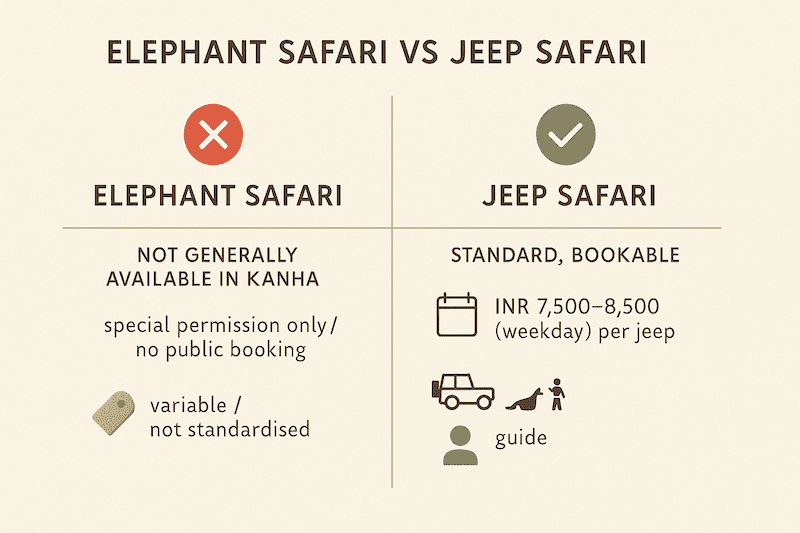
I know, I know. Some websites still list them. You might have seen a price quoted somewhere—maybe INR 500 per person, perhaps even higher. But here’s what actually happens when you try to book one: nothing. Because they’re simply not available as a standard tourist offering.
The forest department at Kanha has essentially phased out elephant safaris for regular wildlife viewing. These magnificent animals are now primarily used for forest department work, research activities, and occasionally for professional film crews or photographers who’ve secured special permission well in advance. And by “well in advance,” I mean the kind of planning that involves written applications to the Field Director, not just an online booking form.
When I dug deeper into this, I learned that if elephant rides do happen, they fall into two categories. There’s the short “joy ride” that lasts about 30 minutes, and then there’s the longer elephant-back safari that can stretch to three hours. But—and this is a big but—approval is entirely case-by-case and typically confirmed only a day before your visit. That makes it essentially unreliable for anyone trying to plan a meaningful wildlife experience.
Several booking portals and safari operators now explicitly state that Kanha offers only jeep safaris for tourists. The elephant safari option? It’s been crossed off the menu, at least for practical purposes.
What the INR 500 Price Tag Really Means (And Why You Can’t Trust It)
So about those prices you’ve seen floating around the internet—let’s talk about why they’re misleading.
I came across several third-party websites quoting figures like INR 500 per person for elephant safaris in Kanha. On the surface, that sounds reasonable, right? Almost affordable compared to other wildlife experiences. But here’s the problem: these rates are either wildly outdated or completely unofficial.
The actual pricing—if you somehow manage to secure permission—is controlled entirely by the park authority. It varies dramatically based on duration, availability, and the specific purpose of the ride. If you’re a filmmaker or photographer seeking a full-day elephant safari for professional work, you’re looking at costs that are substantially higher than regular jeep safaris, and they’re tied to expensive filming permits that need Field Director approval.
Think of it this way: those INR 500 quotes you’re seeing are like finding a restaurant menu from 2010 online and showing up expecting the same prices. The menu might still exist somewhere on the internet, but that doesn’t mean the restaurant is actually serving those dishes at those rates anymore.
I think what frustrates me most about these outdated listings is that they give travelers false hope. You start budgeting for something that doesn’t exist, building expectations around an experience you can’t actually book. It’s better to know the truth now than to show up at the park gates disappointed.
How Elephant Safaris Actually Work in Kanha (If You Can Get One)
Okay, so let’s say you’re determined. Maybe you’re a researcher, or perhaps you’re working on a documentary. Or maybe you just really, really want to try your luck. Here’s what the actual process looks like—or what’s left of it.
The longer elephant safaris in Kanha are essentially tied to full-day filming and photography permissions overseen by the Field Director. These require written applications submitted well in advance of your visit. And by “well in advance,” I’m talking weeks or months, not days. The approval process is uncertain, typically not granted for regular sightseeing, and even when approved, comes with a price tag that reflects its special-permission status.
If you do manage to get approval, you might encounter one of two formats. The shorter joy ride gives you about 30 minutes atop an elephant—basically enough time to say you did it, take a few photos, and that’s about it. The longer safari, which can last around three hours, offers a more immersive experience but is even harder to secure.
The real kicker? Even if you jump through all these hoops, you typically won’t know if you’re confirmed until the day before your scheduled ride. Imagine planning an entire trip around this possibility, only to get a “no” with 24 hours’ notice. Not exactly the foundation for stress-free travel planning, is it?
Conservation priorities have shifted over the years, and I actually respect Kanha’s approach here. Elephants are intelligent, sensitive creatures, and reducing their use for tourist entertainment makes sense from an ethical standpoint. But I do wish the park’s official communications were clearer about this, rather than leaving travelers to figure it out through trial and error.
If you’re curious about which zones offer the best wildlife experiences, I’d focus your attention on understanding the jeep safari zones instead—that’s where your actual adventure will unfold.
Why Jeep Safaris Are Your Best Bet (And What They Cost)
Here’s where the conversation gets more interesting—and more practical. Jeep safaris aren’t just the “second choice” in Kanha; they’re genuinely the best way to experience this incredible reserve. I know that might sound like I’m trying to make you feel better about missing out on elephant rides, but hear me out.
Kanha is divided into core zones and buffer zones, with four main core zones open to tourists: Kanha, Kisli, Mukki, and Sarhi. Each zone has its own character, its own landscape, and its own wildlife patterns. The jeeps can cover much more ground than an elephant ever could, getting you deeper into the forest and to spots where tiger sightings are more likely.
Now, let’s talk numbers—because I know that’s what you’re really wondering about.
For Indian nationals, core zone jeep safaris typically cost between INR 7,500 and INR 8,500 per jeep on weekdays. On weekends, that jumps to approximately INR 8,500 to INR 10,400 per jeep. Each jeep accommodates up to six people, so if you’re traveling in a group, you can split these costs. If you’re solo or a couple, you might end up paying for a private jeep unless you can find other travelers to share with.
Foreign nationals face steeper prices, as is common in Indian national parks. Weekday rates hover around INR 12,000 to INR 15,000 per jeep, while weekend safaris can reach INR 15,000 to INR 18,000.
These prices typically include the vehicle, driver, park entry fees, and often a guide. However, some operators charge separately for naturalist guides, which can add anywhere from INR 800 to INR 2,000 to your total. Always clarify what’s included when you book.
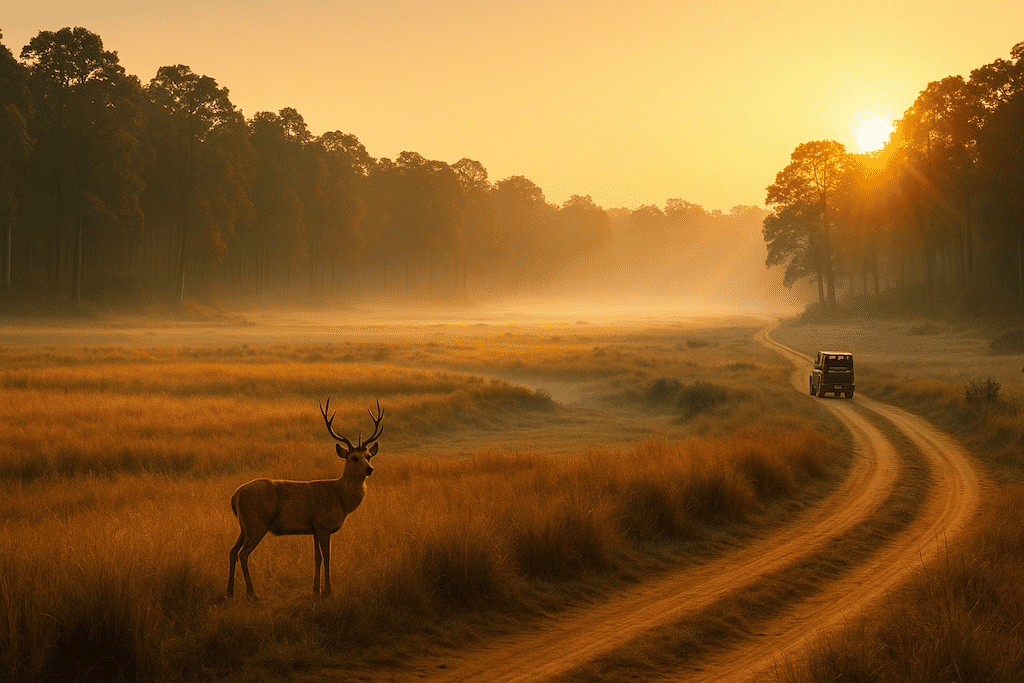
The park offers both morning and afternoon safaris. Morning safaris usually start around 6:00 AM (varying slightly by season) and last about 4-5 hours. Afternoon safaris begin between 3:00 PM and 4:00 PM, running until the park closes at dusk. Many wildlife enthusiasts recommend the morning safari because animals tend to be more active in the cooler hours, though I’ve heard stories of incredible tiger sightings during afternoon drives too.
One crucial detail: you need to book safaris up to 120 days in advance through the official Madhya Pradesh forest department portal or through registered tour operators. During peak season (roughly December through March), slots fill up fast. If you’re serious about visiting, don’t wait until the last minute.
Perhaps surprisingly, I actually found myself preferring the jeep experience. You sit at a good height for photography, you can cover multiple habitats in a single safari, and your experienced driver and guide can respond quickly when they get word of a tiger sighting over the radio. That kind of mobility and communication network doesn’t exist with elephant safaris—even in parks where they’re still offered regularly.
If you’re trying to figure out where to stay based on which safari zones you want to access, location matters more than you might think, especially for those early morning departures.
How Much Is Elephant Safari in Kanha National Park—The Real Answer
Alright, let’s circle back to the question you actually came here with: How much does an elephant safari cost in Kanha National Park?
The honest answer—the one I wish someone had given me straight up when I first started researching—is this: There is no fixed, publicly bookable elephant safari price in Kanha for regular tourists because the service isn’t meaningfully available.
If those outdated INR 500-per-person quotes had any basis in reality years ago, that reality no longer exists. And any elephant ride arrangements that do happen now exist in a completely different category—special permissions for research, filming, or forest department operations—with pricing and logistics that aren’t transparent or standardized for public access.
I know that’s probably frustrating to hear, especially if you’ve traveled to other Indian national parks where elephant safaris are still a thing. Places like Kaziranga in Assam and Jim Corbett in Uttarakhand do offer elephant safaris as regular tourist activities, with clear pricing and booking procedures. In Kaziranga, for example, Indian nationals pay around INR 1,500-INR 1,700 per person for an hour-long elephant safari, while foreigners pay INR 3,500-INR 4,500. Corbett charges approximately INR 3,500 per elephant (accommodating up to four people) for Indians, with similar rates for foreigners.
Those parks have maintained elephant safari programs with proper infrastructure and booking systems. Kanha has deliberately moved in a different direction, prioritizing jeep-based tourism instead.
When I compare the overall experience and value, though, I’m not convinced you’re missing out. The comprehensive cost breakdown of Kanha’s jeep safaris actually represents solid value when you factor in the ground you cover, the expertise of guides, and the genuine likelihood of significant wildlife encounters.
Think of it this way: would you rather spend INR 500 on a maybe-elephant-ride-that-probably-won’t-happen, or allocate that money toward a second jeep safari that’s actually bookable, reliable, and likely to deliver the tiger sightings you’re really hoping for? When I frame it like that, the choice becomes pretty clear.
Alternatives to Elephant Safaris in Kanha
Just because elephant safaris are off the table doesn’t mean you’re stuck with only one way to experience Kanha. In fact, the park and surrounding areas offer several other activities that give you different perspectives on this remarkable ecosystem.
Walking Safaris in Buffer Zones
If what you’re really craving is that slower, more intimate pace that elephants provide, consider a guided walking safari in the buffer zones. The Khatia Trail, just outside the Khatia Gate, is a particularly popular option. This two-hour guided walk takes you through forests where you might encounter spotted deer, sambhar, various bird species, and if you’re lucky, even larger mammals like leopards.
The experience of walking through the forest—actually hearing the crunch of leaves under your feet, smelling the earth and vegetation, hearing birds without the rumble of an engine—creates a connection that’s hard to replicate from any vehicle. You move at the forest’s pace, not yours. It’s meditative in a way I didn’t expect.
Nature Trails and Bird Watching
Kanha is home to over 300 bird species, making it a paradise for bird watchers. Early morning nature trails, often organized by the resorts and lodges around the park, focus specifically on avian life. The Banjar River Trail is especially rich in riparian birds, and walking beside the water as the sun rises is… well, it’s the kind of moment that sticks with you.
Many eco-resorts in the area also offer guided nature walks through the buffer forests adjacent to their properties. These walks often include sessions on identifying medicinal plants, spotting butterflies and insects, and understanding the broader ecosystem beyond just the “star” animals like tigers.
Village Visits and Cultural Experiences
The Gond and Baiga tribal communities have deep historical connections to the forests of Kanha. Some lodges arrange visits to nearby villages where you can learn about traditional crafts, sustainable forest practices, and the complex relationship between local communities and conservation efforts. These visits add crucial context to your wildlife experience—you start to understand the human dimension of wildlife conservation, which is often overlooked in typical safari tourism.
Photography Hides and Watchtowers
For serious wildlife photographers, several areas in and around Kanha offer photography hides near waterholes and salt licks where animals naturally congregate. These stationary positions require patience, but they allow for the kind of intimate, unrushed observation that’s impossible from a moving vehicle.
Similarly, some zones have watchtowers that give you elevated vantage points over meadows and forests. The perspective shift alone makes these worthwhile, and the chance to spot wildlife from above adds another dimension to your visit.
If you’re wondering what else you can do in Kanha beyond the traditional safari experience, you’ll find that the park and its surroundings offer surprising depth. I actually think a trip that combines multiple types of experiences gives you a richer understanding of the place than any single activity ever could.
Other Indian National Parks With Elephant Safaris
If you’re genuinely set on experiencing an elephant safari during your India wildlife trip—and I totally understand if you are—let me point you toward parks where this is actually still a viable option.
Kaziranga National Park, Assam
This is probably your best bet. Kaziranga not only offers elephant safaris but considers them one of the park’s signature experiences. These one-hour rides take you through tall grasslands where one-horned rhinoceros graze, often getting you closer to wildlife than jeeps can manage in those conditions.
Pricing is straightforward: around INR 1,500-INR 1,700 per person for Indian nationals and INR 3,500-INR 4,500 for foreigners. You can book through the official website or local tour operators, with slots typically available in early morning hours. The catch? You usually won’t know your exact time slot until the evening before, but at least the safari itself is confirmed.
Jim Corbett National Park, Uttarakhand
Corbett offers elephant safaris in certain zones, particularly in the reserve forest areas of the Corbett landscape. These rides cost approximately INR 3,500 per elephant for up to four people (for both Indian and foreign nationals), making it relatively affordable if you’re traveling as a group or family.
The elephant safaris here operate both morning and evening slots, giving you some flexibility. However, they’re generally available only to guests staying in certain forest rest houses within the park, which adds a layer of complexity to planning.
Panna National Park, Madhya Pradesh
Though not as widely promoted, Panna does offer limited elephant safari options alongside its jeep and walking safaris. The park’s location near the stunning Raneh Falls makes it worth considering if you’re already planning a Madhya Pradesh wildlife circuit.
The pricing and availability are less standardized than Kaziranga or Corbett, so this would require more upfront communication with tour operators.
I’ll be candid: if elephant safaris are a non-negotiable part of your India wildlife experience, you might want to structure your trip around Kaziranga rather than Kanha. Kaziranga’s elephant safaris are reliable, well-organized, and genuinely enhance your ability to see the park’s famous one-horned rhinos. But if tigers are your primary interest—and let’s be honest, they probably are—Kanha’s jeep safaris give you better odds and better overall tiger habitat coverage than you’ll find in most other parks.
Planning Your Kanha Trip Without Elephant Safaris
So you’ve accepted that elephant safaris aren’t happening. Now what? How do you actually plan a Kanha trip that’s still incredible, meaningful, and worth the time and money you’re investing?
Let me walk you through the practical planning process that I wish I’d understood from the beginning.
Setting Realistic Expectations
First things first: adjust your mental picture. Your Kanha experience will center around jeep safaris, and that’s genuinely exciting. Think of it as an opportunity to cover more ground, access different habitats, and maximize your chances of tiger encounters. The best time to visit for tiger sightings is typically between late October and June, with April and May being particularly productive months as animals congregate around water sources.
Budget Allocation for Jeep Safaris
- Jeep safaris: Plan for at least 4-6 safaris over a 3-4 day visit. At roughly INR 8,000-INR 9,000 per safari (assuming weekend rates and including all fees), budget around INR 35,000-INR 55,000 for safari costs if you’re booking private jeeps. If you’re traveling solo or as a couple and can share jeeps with others, you might reduce this to INR 15,000-INR 25,000 per person.
- Accommodation: Budget hotels near the gates run INR 2,000-INR 4,000 per night, mid-range resorts cost INR 5,000-INR 12,000, while luxury eco-lodges can exceed INR 15,000-INR 30,000 per night. Your choice here depends on how important amenities, naturalist expertise, and overall experience are to you.
- Meals and incidentals: If meals aren’t included in your accommodation, budget INR 1,000-INR 2,000 per day for food.
- Additional activities: Nature walks, village visits, and other experiences typically cost INR 500-INR 2,000 each.
- Transport: Getting to Kanha usually involves flying to Jabalpur or Raipur, then a 3-5 hour drive to the park. Budget INR 3,000-INR 6,000 for airport transfers and local transport.
How Many Safaris to Book
This is a question I struggled with myself. The answer depends partly on luck and partly on strategy. Tiger sightings are never guaranteed—that’s the nature of wildlife—but booking multiple safaris across different zones significantly improves your odds.
I’d recommend a minimum of four safaris if you’re visiting primarily for tigers. Book these across different zones (try to include both Kanha and Mukki zones, which have the best tiger density) and across different times of day. The variety gives you the best chance of hitting the right place at the right time.
If you’re there for the overall experience and not fixated solely on tigers, even two or three safaris can be satisfying, especially if you complement them with walking trails and other activities.
What Else to Budget For
Don’t forget the small extras that add up: tips for drivers and guides (INR 200-INR 500 per safari is customary), battery charging and memory cards for cameras, sunscreen and insect repellent, binoculars if you don’t already own them (essential for bird watching and distant wildlife spotting), and perhaps a field guide to Central Indian wildlife.
Some lodges offer package deals that bundle accommodation, meals, and safaris together. These can actually represent good value, especially during peak season when safari bookings are competitive. The package route also simplifies logistics—someone else handles all the booking coordination, which reduces stress considerably.
Final Thoughts: Why Kanha Is Still Worth Visiting
I’ll admit, when I first learned that elephant safaris weren’t really available in Kanha, I felt a twinge of disappointment. There was something romantic about the idea—that connection to how people explored wildlife a century ago, the slow rhythm, the height advantage.
But after actually experiencing Kanha, I can tell you with complete honesty: I didn’t miss the elephant ride at all.
What I found instead was a park that takes its conservation mission seriously. I found meadows filled with hundreds of barasingha—a deer species that was down to just 66 individuals in the 1960s and has now rebounded to over 800 thanks to dedicated conservation efforts. I found sal forests so dense and beautiful they could have been the setting for Rudyard Kipling’s [Jungle Book](pplx://action/translate) (which, incidentally, was inspired by Kanha). I found guides and naturalists who knew their forest intimately, who could read signs I’d walk right past, who could identify birds by their calls alone.
And yes, I found tigers. Not on every safari—that would be unrealistic—but when those encounters happened, they were electrifying. The moment a tigress emerged from the shadows and crossed the road thirty meters from our jeep, time seemed to slow. Every detail became vivid: the muscular grace of her movement, the intensity in her eyes, the collective held breath of everyone in the vehicle.
That moment didn’t require an elephant. It just required being in the right place, with knowledgeable people, in a park that’s been protecting tigers for decades.
The shift away from elephant tourism in Kanha reflects a broader evolution in how we think about wildlife experiences. It’s less about entertaining tourists and more about respecting wild spaces and the animals within them—including the elephants themselves. I think that’s actually something to celebrate, even if it means letting go of certain romanticized images we carried in our heads.
So if you’re still wondering whether Kanha is worth visiting without elephant safaris, let me answer definitively: absolutely yes. Come for the tigers, stay for the barasingha, the leopards, the sloth bears, the incredible birdlife, the landscapes that shift from grassland to forest within minutes. Come for the morning mist rising over meadows, the cacophony of langur alarm calls announcing a predator’s presence, the peacocks displaying their full plumage in afternoon light.
Come with realistic expectations, proper planning, and openness to the experience the park actually offers rather than the one you imagined. When you approach Kanha that way, it won’t disappoint.
And who knows? Maybe ten years from now, you’ll find yourself recommending Kanha to someone else, and when they ask about elephant safaris, you’ll smile knowingly and say, “You don’t need them. Trust me on this.” That’s where I am now, and I think that’s where you’ll be too.
Safe travels, and may your safaris be filled with incredible sightings—elephants or no elephants.