If you’ve ever stared at the booking portal wondering which zone to pick—Kanha, Kisli, Mukki, or Sarhi—you’re not alone. The truth is, each zone has its own mood, landscape, and rhythm. And while people love to argue that one is “best,” sightings in Kanha shift with seasons, water, and tiger territories. So rather than chasing a single answer, it’s smarter (and frankly more fun) to understand what each zone brings to the table, how gates map to zones, and how to plan a mix that stacks the odds in your favor without overcomplicating your trip.
Here’s a clear, traveler-tested breakdown of the four core zones and their entrance gates, along with planning strategies that blend practicality with your inner wildlife geek. Think informed decisions, not guesswork. And yes, if you’re still booking, make sure you’ve skimmed the full Kanha safari booking guide so you don’t miss out on permits due to timing.
How zones and gates actually work
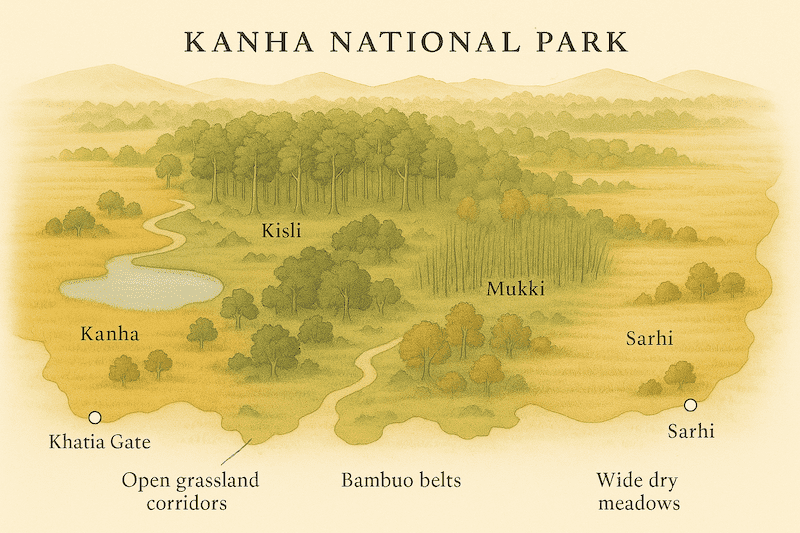
Kanha has four core safari zones—Kanha, Kisli, Mukki, and Sarhi—and three main gates that tourists use: Khatia, Mukki, and Sarhi. You book by zone, but you enter via a gate that provides access to that zone; some zones are reachable from multiple gates, though the approach distance varies and can be long across forest roads if you mismatch gate and zone. Khatia is the most flexible because it connects to all four core zones and gives you Kisli as a “pass-through” en route to others, which is handy if you value variety in a short trip.
-
- Khatia Gate: Access to Kanha, Kisli, Mukki, Sarhi (core) and Khatia (buffer); it’s the most versatile for mixed itineraries and often the easiest for logistics and stays near Mocha/Khatia villages.
-
- Mukki Gate: Best for Mukki, with access to Kanha and Kisli as well; connects to Khapa buffer and sits closer to the southern grasslands and bamboo belts many guides favor for tigers.
-
- Sarhi Gate: Northern entry that reaches Sarhi, plus Kanha and Kisli; quieter, with bigger meadows and drier deciduous stretches, good if you prefer fewer vehicles at sightings.
Important: Distances between a booked zone and the “wrong” gate can eat into your safari time—reaching Mukki zone from the Khatia side, for instance, can take a long, bumpy forest link; align your stay and gate to your booked zones wherever possible.
Zone by zone: feel, routes, and what to expect
Kanha Zone
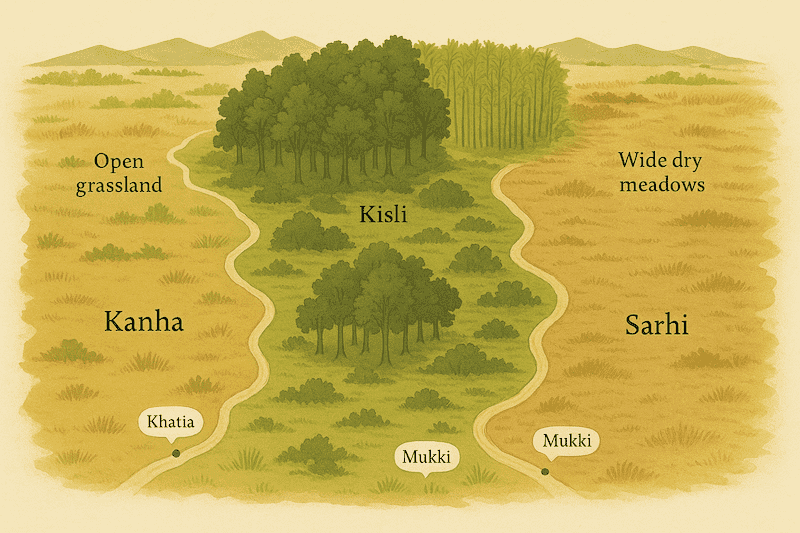
Think classic Kanha: rolling meadows, iconic grasslands, and sal-bamboo mosaics with wide visibility when vegetation thins from February onward. Kanha is central and scenic, often associated with big open meadows that make wildlife tracking slightly easier once grasses drop; many visitors consider it the quintessential “postcard” Kanha experience. It’s accessible from Khatia, Mukki, and Sarhi, with Khatia being the most common entrance if you’re staying near Mocha/Khatia.
-
- Why choose it: Balanced routes, photogenic meadows, and reliable mixed sightings across seasons; pairs well with Kisli for variety in short trips.
-
- Good to know: In October–early November, fresh post-monsoon growth can be tall, reducing visibility; by Feb–May, sightlines and waterhole patterns improve dramatically.
Kisli Zone
Kisli is sal forest elegance—airy sal stands, bamboo, and grassland pockets, with classic Central Indian jungle ambience. It’s effectively the connective tissue from Khatia into the core, and even when you’re allocated another zone, you often traverse Kisli stretches first. That “bonus” time means chance sightings before you even hit your primary loop.
-
- Why choose it: Beautiful sal drives, consistent general wildlife, and decent tiger potential—especially as grasses thin; complements Kanha zone very well.
-
- Good to know: Visibility in deep sal is lower than in open meadows; rely on alarm calls and guide intel more than long-range scanning here.
Mukki Zone
Mukki has a strong reputation for tiger sightings year after year, thanks to a mix of bamboo thickets, grasslands, and good water-linked routes that concentrate movement in hot months. Many recent-season trackers favor Mukki for high-probability encounters, though performance always depends on current territories and water.
-
- Why choose it: If tiger sightings are top priority, especially March–June when waterholes pattern movement; southern access makes it convenient if you stay near Mukki lodges.
-
- Good to know: It can get popular with serious photographers and long-lens groups; book early and align your gate and accommodation to avoid long transfers.
Sarhi Zone
Sarhi sits to the north with big meadows and drier deciduous stretches, plus those long sal corridors you cross via Kisli when coming from Khatia. It’s generally quieter, which some travelers love—fewer jeeps pressing sightings, more tranquil drives, and big-sky grassland scenes when light is right.
-
- Why choose it: More solitude, larger meadows, and excellent landscape photography in winter-spring; good mix with Kanha or Kisli in multi-safari plans.
-
- Good to know: If the buzz is in Mukki on a given week, Sarhi may feel calm by comparison; local guide intel matters to maximize your loops here.
Which zone is “best” for tigers?
Short answer: it changes. The slightly longer—but honest—answer is that Mukki and Kanha often edge ahead on tiger chatter, with Kisli steady and Sarhi more variable; still, any zone can turn electric if a resident tigress with cubs anchors near a drivable loop for a few weeks. The pattern also shifts with season: March–June pushes cats to fewer water sources and simplifies your strategy, while November–January rewards patience and audio tracking in taller grass and morning mist.
-
- If sighting odds are your priority: stack 2–3 drives in Mukki plus 1–2 in Kanha, then add Kisli or Sarhi for variety and route coverage.
-
- If you want iconic scenery plus good chances: Kanha + Kisli is a classy winter combination; add Mukki if you can secure it in peak months.
-
- If you prefer quieter loops: include Sarhi, especially from late Jan to March when grass drops and meadows open up.
Gate-to-zone mapping made simple
Use this as a planning rule of thumb when locking accommodation and entry gates to your bookings:
-
- Khatia Gate: Best hub for mixed itineraries; reaches Kanha, Kisli, Sarhi, and even Mukki, and always includes Kisli stretches en route; stay near Mocha/Khatia for earliest starts.
-
- Mukki Gate: Ideal for Mukki-heavy plans; also reaches Kanha and Kisli; best if tiger-first itineraries dominate March–June; stay near Mukki lodges to cut travel time.
-
- Sarhi Gate: Best for Sarhi-focused drives plus Kanha/Kisli options; a quieter tourism cluster with long open meadows in reach; plan around fewer dining options than Khatia.
Note: While some sources claim you can reach “any” zone from “any” gate, that flexibility can cost you an hour or more each way across forest connectors. Matching your gate to your most-booked zone protects precious dawn and dusk minutes when activity peaks.
Seasonal zone strategy
-
- Oct–Nov: Lush, tall grass; favor zones with broader meadows and navigable water loops—Kanha + Sarhi for landscapes; add Mukki if intel says a family is active on-drivable routes.
-
- Dec–Jan: Cold, misty starts; Kisli sal corridors can be magical post-fog; target Kanha meadows for basking behavior; add Mukki where guides report reliable waterhole routines.
-
- Feb–Mar: Visibility improves; mix Kanha + Mukki for balanced odds, add Kisli for sal drives when light softens; Sarhi meadows open nicely in this window.
-
- Apr–Jun: Heat concentrates movement; prioritize Mukki and Kanha around key water; use Sarhi afternoons for big-meadow light; keep drives focused and water-centric.
How many safaris per zone?
Across a 4–6 safari plan, aim for a 2–2–1–1 distribution among Mukki, Kanha, Kisli, and Sarhi, then shift one slot based on current guide intel (e.g., push a third Mukki if there’s a reliable waterhole routine running). If you have only 3–4 safaris, make Mukki + Kanha your base pair, then add Kisli or Sarhi for diversity and route coverage.
Where to stay for each plan
-
- Mukki-heavy plan: Base near Mukki gate to save transfers; popular with photographers in summer; quieter vibe than Khatia cluster.
-
- Khatia flexible plan: Stay near Khatia/Mocha for access to all four core zones, more dining choices, and easier logistics if your permits span zones.
-
- Sarhi-focused plan: Limited stays, quieter ambiance, and longer internal meadows; rewarding if you value fewer jeeps at sightings.
If you’re still weighing areas, this detailed accommodation-by-gate guide helps you align lodges with zone choices sensibly.
Practical booking and on-ground tips
-
- Book zones early, then lock a lodge near the right gate; flipping that order can cost you prime morning minutes to long transfers.
-
- Don’t overfit rumors; zone “form” changes with territories and cubs; two weeks can flip the script—trust current guide intel when you arrive.
-
- Mix morning and afternoon across zones; Mukki dawn + Kanha dusk is a strong 1–2 punch in hot months; in winter, let fog lift before committing to deep-sal loops.
-
- Respect zone boundaries; you can’t hop mid-safari; plan your routes around water and meadows first in summer, around calls and corridors in winter.
Quick comparisons
-
- Most versatile for first-timers: Kanha + Kisli from Khatia; add Mukki if you can secure it.
-
- Highest tiger buzz historically: Mukki edges it, with Kanha close; depends on current territories.
-
- Quiet drives and big meadow frames: Sarhi, especially late winter into spring.
-
- Sal-forest ambience and steady wildlife: Kisli, with surprise tigers when calls align.
If you’re still planning your season and dates, the full best-time-to-visit guide pairs well with this zones breakdown, so the “when” and “where” of your itinerary reinforce each other instead of working at cross purposes.
Final take: build for balance, then adapt
The smartest Kanha zone plan builds a balanced base—Mukki + Kanha for probability, Kisli + Sarhi for texture—and then adapts when you arrive based on real-time sign: fresh pugmarks, alarm calls, water levels, and what guides are seeing that week. It’s tempting to chase yesterday’s sighting, but the forest shifts hour by hour. Great trips happen when your plan is solid, but your mindset stays flexible—and when your gate, lodge, and zone choices respect the map, not fight it.